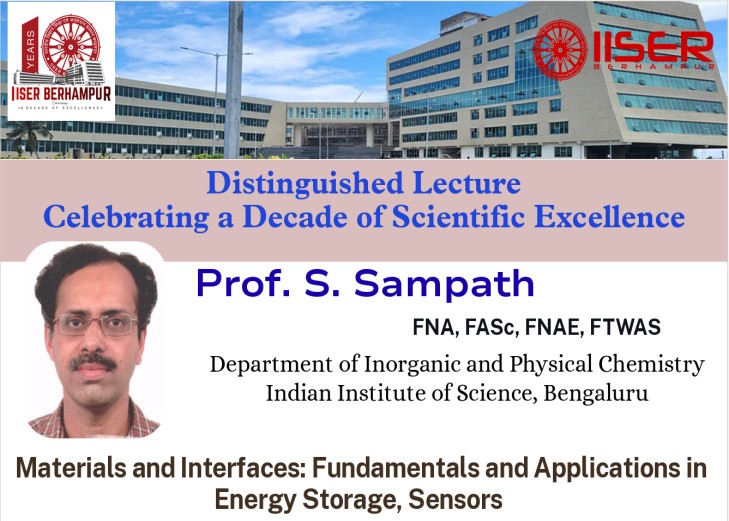
Date: January 22, 2026
Time: 05:30 PM
Venue: Lecture Hall 1003, Block 7, IISER Berhampur
Flyer Link: Click here to view
Applications of the Two Dimensional Materials for Energy Storage: Battery Electrodes, Electrolytes and Multi-functional Electrocatalysis
Among various two-dimensional (2D) materials, graphene possesses similar interlayer spacing of multiwalled carbon nanotubes (0.32−0.35 nm) which could be modulated by several strategies such as the intercalation of cations and anions, the nature of the solvent, and surface functionalization. The resultant graphene nanoribbons ( 40 nm diameter) formed by the ionic liquid-assisted transformation of multiwalled carbon nanotubes of an average diameter ( 21 nm) along with graphene quantum dots having an emission wavelength of 445 nm are more useful for some of the specific applications. The tunability of this spacing depends on the nature of the ionic liquid, the size of the incoming ions, the applied potential, and the time. In this lecture several examples of electrochemically prepared 2D materials, their heteroatom doping and surface modification possibility will be discussed using both elemental and compound 2D quantum dots like Graphene, Phosphorene, carbon nitride, Molybdenum Sulphide, Bismuthene and clay based 2D composites will be demonstrated for specific applications like electrocatalysis and battery storage.
Prof. Vijay M. Pillai - Professor Vijayamohanan K. Pillai, is a distinguished Indian electrochemist and materials scientist, and currently Professor of Chemistry at the Indian Institute of Science Education and Research (IISER), Tirupati. He obtained his Ph.D. in Electrochemistry/Materials Science from the Indian Institute of Science, Bengaluru and has over three decades of experience spanning materials electrochemistry, nanostructured materials, energy storage, and two-dimensional materials for electrochemical applications. Prof. Pillai has authored more than 250 peer-reviewed publications and holds around 20 patents, with seminal contributions to batteries, fuel cells, electrochemical sensors, hybrid nanomaterials, and electrocatalysis. He has held key leadership positions including Director of the CSIR-Central Electrochemical Research Institute (CECRI), Karaikudi and Director of CSIR-National Chemical Laboratory (NCL), Pune. His work has been recognised with numerous honours including the J. C. Bose National Fellowship from the Department of Science & Technology, Government of India, and fellowships of major science academies, and he serves on editorial boards of several international journals. Prof. Pillai’s current research focuses on advanced two-dimensional materials for energy storage and conversion, making him an ideal speaker for this colloquium.