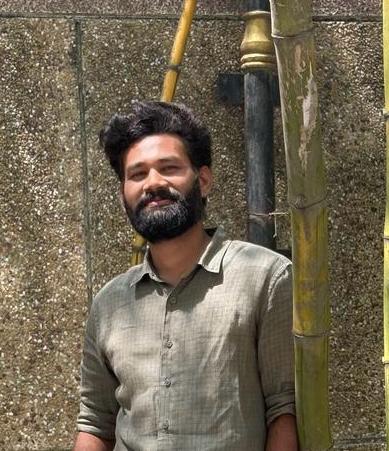
Dr. Chandan Kumar is a linguist whose work moves across language, culture, cognition, technology, and society, treating each as inseparable from the others.
He received his Ph.D. in Linguistics from Jawaharlal Nehru University (JNU), New Delhi, where his doctoral research examined the typology of nominal modifiers across major languages of Bihar. This early commitment to the lesser-described languages of eastern India continues to anchor his broader research interests, which span linguistic typology, morphosyntax, multilingualism, language documentation, language pedagogy, and second language acquisition. Across these strands runs a single conviction: that grammar is never merely structural, but a repository of memory, identity, and social life, and that to document a language's morphosyntax is also to argue for the legitimacy of the worldview it encodes.
Before joining IISER Berhampur, he taught at Christ University, Bengaluru, and served as a Fulbright Fellow and Teaching Associate at the University of Illinois Chicago, where he taught language and culture — an experience that deepened his sense of language as a lived, relational practice rather than an abstract system.
Jose, J., Kumar, C. (2026). Decolonizing Environmental Governance: An Ecolinguistic Critique of Indian Forest Laws and the Promise of Indigenous Ecosophies. In: Wagner, A. (eds) International Handbook of Legal Language and Communication. Springer, Cham. https://doi.org/10.1007/978-3-031-87993-7_361-1
Borsari, B., Vidrine, M.F., Jose, J., Kumar, C. (2026). Indigenous Wisdom Farming Emphasis for Climate-Resilient Food Systems and the Agroecology Nexus to Rewilded Agroecosystems. In: Leal Filho, W., Matandirotya, N., Yayeh Ayal, D., Luetz, J.M., Borsari, B. (eds) Climate Change, Food Security, and Land Management. Springer, Cham. https://doi.org/10.1007/978-3-031-71164-0_85-1
Kumar, C., Thomas K, N. (2026). Language Policies and Internationalization in Indian Higher Education. In: Mammadova, T., Curle, S., Yuksel, D., Allen, T.J. (eds) Englishisation and Multilingual Dynamics in Higher Education. Palgrave Macmillan, Cham. https://doi.org/10.1007/978-3-032-19906-5_2
Thomas K, N., & Kumar, C. (2026). The Entangled and Polyphonic Dynamics of Folk Memory: The Legend of Kadamattathu Kathanar. Folklore, 137(2), 345–367. Taylor & Francis. Routledge. https://doi.org/10.1080/0015587X.2026.2652204
Kumar, C. (March, 2026). Separate Electorate in the book of ‘Dalit Studies: Key Terms and Concepts’ edited by Dr Kondekar & Dr Mandal. Publisher, Routledge. 10.4324/9781003634010-48
Kumar, C. & Thomas, N.K. (Feb 2026). Artificial Intelligence in Language Teaching: Exploring Translanguaging, Eco-linguistics, and Community-based Learning. In the edited book titled ‘Community-Based Language Learning and Cultural Competence’. Publisher IGI Global. 10.4018/979-8-3373-0030-6.ch002
Joseph, A. K. & Kumar, Chandan. (Dec 2025) Dyslexia, Memoir, and the Epiphanic Tapestry of Resilience: A Disability Studies Reframing. In the Journal of Literary and Cultural Disability Studies. Liverpool Hope University. https://doi.org/10.3828/jlcds.2025.48
Kumar, C., & Thomas, N. K. (2024). Discourse of dissent: Languaging resistance and consciousness in subaltern literatures – Dalit and Black. Studies in Linguistics, Culture, and FLT,12(2). (144-166) https://silc.fhn-shu.com/issues/2024-2/SILC_2024_Vol_12_Issue_2_144-166_23.pdf
Kumar, C. and Thomas, K, N. (2024). Populism and Folk Performance. In: Chacko Chennattuserry, J., Deshpande, M., Hong P. (eds) Encyclopedia of New Populism and Responses in the 21st Century. Springer, Singapore. https://doi.org/10.1007/978-981-16-9859-0_376-1
Kumar, C. (2024). Numeral Classifier and Plurality: The Puzzle of Quantification in Magahi. Journal of South Asian Linguistics. 13 (1), 1-16. UGC care list 1.
Kumar, C. (2023). Unraveling Fluid Identities: Exploring the Migration of Gendered Semiotics in Magahi across Caste, Culture, and Pragmatics. Migration Letters, 20(S9), 1622-1642.
Kumar, C. (2023). Echo Construction and Ad hoc Categories: Semantics of Group Reference in Magahi. Rupkatha Journal on Interdisciplinary Studies in Humanities, 15(2). https://doi.org/10.21659/rupkatha.v15n2.
Kumar, C. (2022). Multiple Determiners in Magahi: DP structure and the complex N. Linguistics and Literature Studies, 10(2) 11-24. http://www.hrpub.org DOI: 10.13189/lls.2022.100201
Kumar, C. (2022). Multiple determiners in Magahi: A case beyond agreement. Indian Journal of Language and Linguistics, 3 (1), 32-45. Published by Asian Research Association. ISSN – 2582-9726. 4/24, Kumarapuram, 641301, Tamil Nadu, India. DOI: 10.54392/ijll2213
Kumar, C. (2020). NP/DP Parameter and Classifier Languages: A Case of Magahi. The Journal of Indian and Asian Studies, 1(01), 2050005. A peer-reviewed, open-access international academic Journal, jointly published by Hankuk University and World Scientific Publishing Co. Pte. Ltd. (Singapore). The paper also received an honorarium of USD 1000. ISSN (online): 2717-5766. Vol 1 (01), PP. 1-24, January, 2020. https://doi.org/10.1142/S2717541320500059 https://www.worldscientific.com/worldscinet/jias
Co-Principal Investigator (Co-PI) in the research project titled: “Lambani-English Bilingual Dictionary Development for Inclusive Education: Promoting English Acquisition through Mother Tongue Integration among Lambani Learners in India” This project has been awarded a grant of £4160 by the A.S. Hornby Educational Trust, UK, under the Hornby Dictionary Research Awards 2025-27.

