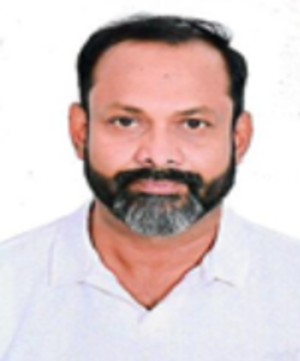
I was born and raised in Kollam, a picturesque coastal town in Keralam. During the initial years of my schooling I was attracted to the subject Physics; partly because, I could understand that subject relatively better than any other subjects and also thankful to my teacher the way he taught me. Being enthusiastic in the subject, I opted for a B.Sc. degree in Physics at Sree Narayana College for Men’s in Kollam. That three-year course unfolded before me the different realms of the subject, particularly Applied Physics. A casual reading about ‘gigantic underwater mountains and trenches’ fascinated me and prompted me to delve into the field of Marine Geophysics, where I subsequently earned an M. Sc. (Tech.) degree from the Dept. of Marine Geology & Marine Geophysics at the Cochin University of Science and Technology. My trajectory towards research was moulded when I got an opportunity to know much about submarine a-seismic ridges and trench systems in the Bay of Bengal as the part of my Masters Dissertation work in ONGC, Dehradun. A national research fellowship instituted by the Physical Research Laboratory (PRL), under the Dept. of Space gave me new wings to build my research career in Marine Geophysics with active support from the Space Applications Centre, Ahmedabad. I was awarded the Ph.D degree by the faculty of Physics, Gujarat University. In the course of my research I realized that oceans can talk only one part of the story related with the geodynamic evolution of the Indian plate. But what remains or still to be known is the crust-lithospheric dynamics of continental India, the role of Himalaya in defining the crustal deformation, earthquakes and crustal structure and how that are connected and integrated with the overall tectonic mosaic of the Indian plate. With this aim, I kick-started my professional career as a Scientist at Wadia Institute of Himalayan Geology, Dehradun and continued there till 30/04/2026. My curiosity driven career as a researcher from the ‘fathoms of oceans to the summit of Himalaya’ is further extended as a teacher here in IISER.
John P.P, Rajesh S., Param K Gautam & Pal S. K., (2021), Crustal velocity and interseismic strain‑rate on possible zones for large earthquakes in the Garhwal–Kumaun Himalaya, Springer Nature portfolio Journal; Scientific Reports, 11, 21283; https://doi.org/10.1038/s41598-021-00484-3 (Written with my Ph.D student)
Sreejith K. M., Rajesh S., Majumdar T. J., Rao G. S., Radhakrishna M., Krishna K. S., and Rajawat A. S., (2013), High-resolution residual geoid and gravity anomaly data of the Northern Indian Ocean – An input to geological understanding, Journal of Asian Earth Sciences (JAES), Elsevier Publications, ISSN: 1367-9120, Vol. 62, 2013, p. 616. http://dx.doi.org/10.1016/j.jseaes.2012.11.010, (Inter institutional collaborative project)
Rajesh, S., and Majumdar, T. J., (2004), '3-D geoidal surface of the Bay of Bengal lithosphere and its tectonic implications'. International Journal of Remote Sensing (IJRS), UK. Taylor and Francis Publications, ISSN: 0143-1161, Vol. 25, No. 15, p.2897.
Rajesh S., and Majumdar T. J., (2010), Geoid versus topography of the Northern Ninetyeast Ridge: implications on crustal compensation, Marine Geophysical Researches (MGR), Springer Publications, ISSN: 1573-0581 (Online), 2010 Dec, Vol. 30, p.251, DOI 10.1007/s11001-010-9088-7
Rajesh S., Anil K. Mundepi and Naresh Kumar, (2017), Quantifying seismic vulnerability, dynamical shear strain and liquefaction of the Quaternary deposits in the Doon valley near the Main Boundary Thrust in the Northwest Himalaya, India, Journal Quaternary International, Elsevier Publications, Vol. 462, p.162-175 http://dx.doi.org/10.1016/j.quaint.2017.05.018
John P. Pappachen, Hamdan A. Hamdan, Rajesh S., Abdollah Masoud D, Abdallah Shanableh, (2024) ‘Possible seismo‑ionospheric anomalies of Mw 6.0 and 6.4 south Iran twin earthquakes on 14 November 2021 from GPS and ionosonde observations. Springer Journal, Arabian Journal of Geosciences (2024) 17:201, https://doi.org/10.1007/s12517-024-12005-3; (foreign collaboration )
1.
(a). Ongoing Project
1. Crust-lithospheric flexure, regional kinematic deformation and seismic anisotropy in the Northwest and the Arunachal Himalaya. (with WIHG as the part of 2025-2030 research plan)
(b) Completed Projects
1. ‘Establishment of continuously operating permanent GPS stations at Panamik in J&K and Pithoragarh in Uttarakhand region’. Funded by Ministry of Earth Sciences (MoES), 2011-2014, Rs. 70 Lakhs
2. ‘Geodynamics and seismicity investigations in the Northwest Himalaya’. Funded by ISRO/IIRS, Dehradun; 2014-2018, Rs. 87.6 Lakhs
3. ‘Geodynamic evolution of the Indian Plate through high resolution geoid/gravity derived from Saral/Altika radar Altimeter data’; Funded by ISRO/SAC, Ahmedabad; 2011-2013, Rs. 7.5 Lakhs

